


AI Reshapes Global Workforce as UN Report Warns of Skills Gap in 2026
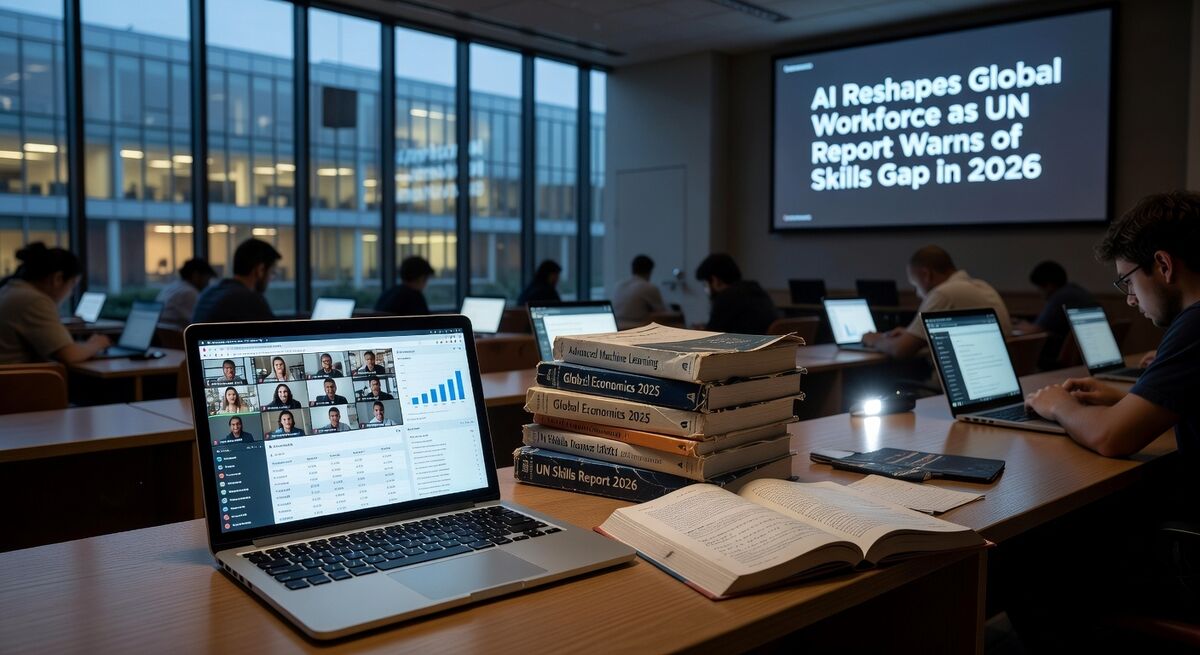
AI Reshapes Global Workforce as UN Report Warns of Skills Gap in 2026
AI Reshapes Global Workforce as UN Report Warns of Skills Gap in 2026
In March 2026 the United Nations released its Global Skills Outlook, revealing that more than 40 percent of the current workforce lacks basic competencies in artificial intelligence. The report links this shortfall directly to slowing productivity growth across both developed and emerging economies. Economists at the UN note that while AI adoption continues to accelerate, millions of roles in finance, logistics and creative industries now require workers who can understand, deploy and oversee intelligent systems.
The findings arrive at a moment when many companies are pausing traditional hiring in favour of targeted reskilling programmes. Governments from Singapore to Germany have already announced subsidies for short-cycle training that focuses on AI tools. For individuals, the message is clear: credentials that demonstrate current AI knowledge are becoming essential for career stability.
Why Traditional Degrees Alone May No Longer Suffice
Historically a university qualification opened doors for decades. Today, the pace of AI change means knowledge acquired even three years ago can feel outdated. The UN report highlights that employers increasingly value demonstrated skills over pedigree. This shift has boosted interest in flexible learning paths that combine academic rigour with immediate practical application.
An online degree now often incorporates live projects using the latest large-language models and computer-vision platforms. Students can complete coursework around existing jobs, a flexibility that proves vital during economic uncertainty. At the same time, standalone certification programmes allow professionals to add targeted credentials without committing to a full degree.
The Surge in Demand for AI Courses
Platforms report record enrolment in AI courses since the start of 2026. Learners range from mid-career marketers seeking to automate campaign analysis to engineers updating their machine-learning portfolios. Many of these programmes culminate in recognised certifications from universities or industry bodies, giving graduates tangible proof of new capabilities.
Crucially, the strongest programmes blend theory with portfolio-ready projects. Participants finish with case studies that show they can fine-tune models, address bias and measure real business impact. Such evidence carries weight in hiring processes that now routinely include technical interviews focused on AI ethics and deployment.
What This Means For You
If you are weighing education options in light of the UN findings, begin by mapping your current role against the skills the report flags as critical. Roles involving data interpretation, process automation or customer-experience design are changing fastest.
Next, compare delivery formats. An online degree from an accredited institution provides broad foundational knowledge and may qualify for employer tuition assistance. A shorter certification in a specific AI course can deliver quicker returns and serve as a stepping stone toward a full degree later. Look for programmes that publish employment outcomes and maintain active industry advisory boards.
Practical steps include:
- Reviewing course syllabi for coverage of prompt engineering, model evaluation and responsible AI governance - Checking whether projects use current tools such as GPT-4 derivatives or open-source frameworks - Confirming that assessments include peer review and real-world datasets rather than multiple-choice quizzes alone - Verifying accreditation status and whether credits can transfer if you later pursue a longer qualification
Budget considerations matter too. Many platforms now offer income-share agreements or modular payment plans that reduce upfront costs. Government subsidies in several countries further lower barriers for citizens enrolling in AI-focused certification tracks.
Balancing Quality and Accessibility
Not every online programme delivers equal value. Established universities have partnered with platforms to maintain academic standards while reaching global audiences. Independent providers often move faster in updating content but may lack formal recognition. Readers should examine sample lectures, speak with recent graduates and review independent course ratings before committing time or money.
The UN report emphasises that lifelong learning is no longer optional. Professionals who treat education as an ongoing investment rather than a one-time event are better positioned to navigate the AI-driven labour market now unfolding.
Always conduct your own research and consult qualified professionals before making enrolment decisions.
- Breaking News Analysis
- World Politics
- Business & Economy
- Technology & AI
- Science & Health
- Environment & Climate
- Culture & Society
- Travel & Tourism
- Sports & Entertainment
- Investigative Journalism
- Opinion & Commentary
- Media & Journalism
- Human Rights & Social Issues
- Education & Knowledge
- Citizen & Amateur Journalism
- Other News Topics

 English
 Arabic
 French
 Spanish
 Portuguese
 Deutsch
 Turkish
 Italiano
 Russian
 Romaian
 Portuguese (Brazil)
 Greek
Greek