


How ‘Securitization’ Fuels Racism and Xenophobia | UN Expert
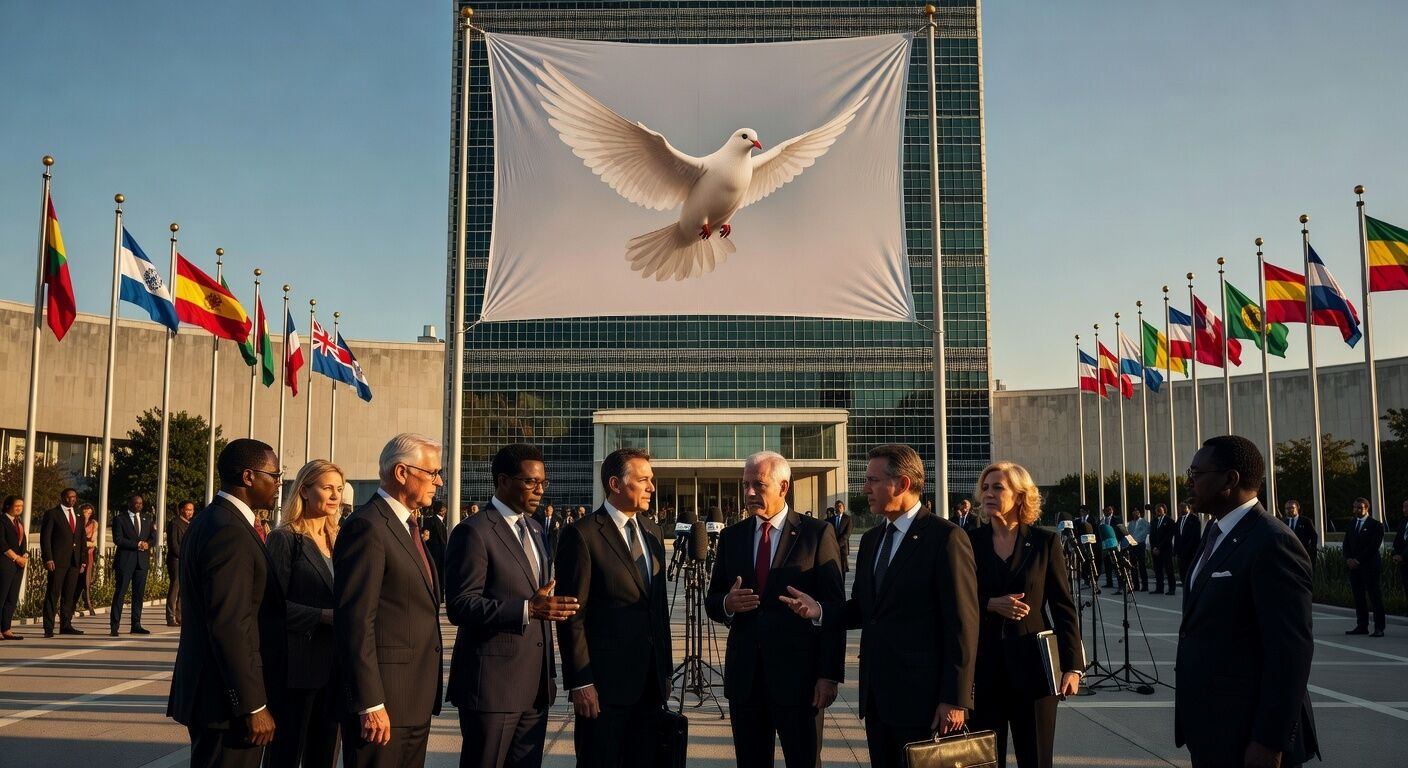
How ‘Securitization’ Fuels Racism and Xenophobia | UN Expert
UN Expert Warns: 'Securitization' of Borders Fuels Racism and Xenophobia Worldwide
Ramallah, May 13, 2026 — In a stark new assessment released yesterday, a United Nations human rights expert has laid bare how the global turn toward "securitization" is systematically entrenching racism, xenophobia, and the criminalization of movement itself. The video briefing, published by the UN Human Rights office on May 12, comes at a moment when displacement numbers have surged past 120 million and governments from Europe to the Middle East continue to frame migration as an existential security threat rather than a humanitarian imperative.
What Securitization Really Means
Securitization, the expert explained, is the process by which everyday issues—refugee arrivals, border crossings, even cultural diversity, are recast as dangers requiring emergency measures. Once an issue is labeled a security threat, normal human-rights safeguards can be suspended. Surveillance expands, detention becomes normalized, and entire communities are profiled on the basis of nationality, religion, or skin color.
"Securitization does not make people safer," the expert stated. "It manufactures fear and then profits from it, politically, financially, and ideologically."
From the Mediterranean to the Jordan Valley
Nowhere is this pattern more visible than along the routes taken by those fleeing conflict and climate collapse. In the Mediterranean, naval operations once tasked with rescue have been repurposed for interception and pushbacks. In North America, walls and biometric databases multiply under the banner of "border security." Here in the occupied Palestinian territories, the language of security has justified decades of movement restrictions, home demolitions, and the separation barrier, measures that international bodies have repeatedly found to be discriminatory in both intent and effect.
The UN expert singled out how these policies disproportionately target people from the Global South. Young men from sub-Saharan Africa or South Asia are routinely labeled "potential terrorists" or "economic migrants" in a single breath, while similar movements by Europeans or North Americans are celebrated as tourism or business travel.
The Human Cost in Real Time
Consider the recent surge in deportations across several European states. Families who have lived in a country for years are removed overnight, children pulled from schools, because an algorithm flagged their neighborhood as "high-risk." In the United States, expanded expedited-removal zones now stretch deep into the interior, catching long-term residents whose only "crime" was crossing a line drawn on a map decades ago.
In my own reporting from Ramallah, I have watched similar logics applied to Palestinian families whose residency permits are revoked under opaque "security" criteria. The result is the same: fractured communities, generational trauma, and the normalization of exclusion.
Economic and Political Incentives
The briefing also highlighted the lucrative industry that has grown around securitization. Private contractors build detention centers, sell facial-recognition software, and train border guards. Politicians gain votes by promising ever-tougher measures. The cycle is self-reinforcing: fear generates funding, funding generates more fear.
Civil-society groups are pushing back. Yesterday's statement echoed calls from dozens of organizations urging states to adopt a human-rights-based approach centered on safe pathways, accountability for pushbacks, and the decriminalization of irregular entry.
A Call for Dignity Over Division
The UN expert closed with a direct appeal: security and human rights are not opposing values. True security, she argued, comes from addressing root causes, inequality, conflict, climate disruption, rather than militarizing the symptoms.
As someone who has covered displacement from Gaza to the Aegean, I have seen how quickly "security" rhetoric hardens into walls, both physical and psychological. The antidote is not more surveillance, but more solidarity: recognizing that every person on the move carries the same fundamental dignity as those who remain behind fences.
Yesterday's briefing is report. It is a warning that the world's current trajectory risks normalizing a global apartheid of movement. The choice before us is clear: continue down the path of securitized exclusion, or reclaim the principle that borders should serve people, not the other way around.
---
Further Reading - UN Human Rights Office video briefing (May 12, 2026) - OHCHR report on contemporary forms of racism in migration governance
Source: UN Human Rights via YouTube — 2026-05-12T18:12:09+00:00.

- Breaking News Analysis
- World Politics
- Business & Economy
- Technology & AI
- Science & Health
- Environment & Climate
- Culture & Society
- Travel & Tourism
- Sports & Entertainment
- Investigative Journalism
- Opinion & Commentary
- Media & Journalism
- Human Rights & Social Issues
- Education & Knowledge
- Citizen & Amateur Journalism
- Other News Topics

 English
 Arabic
 French
 Spanish
 Portuguese
 Deutsch
 Dutch
Dutch
 Italiano
 Russian
 Romaian
 Portuguese (Brazil)
 Greek
Greek