


UN resolution calls for freedom of navigation in the Strait of Hormuz
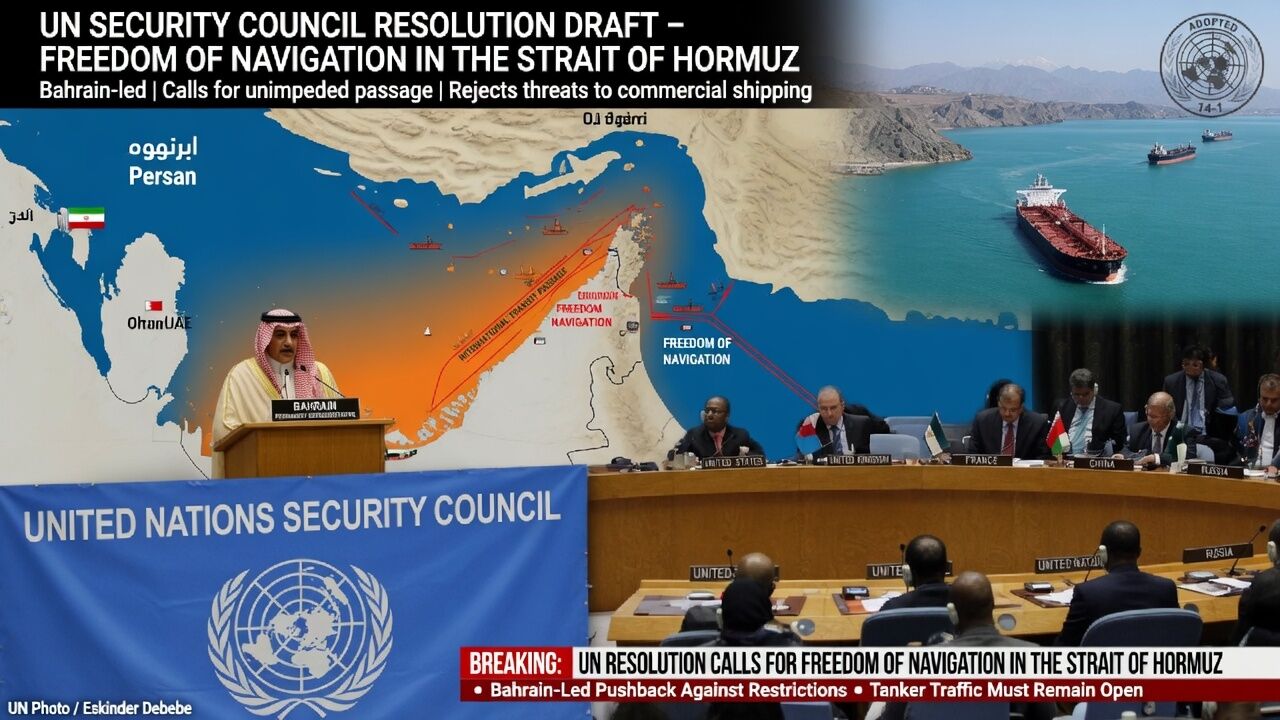
UN resolution calls for freedom of navigation in the Strait of Hormuz
UN Security Council Pushes Back: Bahrain-Led Resolution Demands Freedom in the Strait of Hormuz
Just hours ago, the world watched as Bahrain dropped a diplomatic bombshell at the United Nations. A draft Security Council resolution is now racing toward a vote, backed by a staggering 112 co-sponsors. It calls for immediate freedom of navigation through the Strait of Hormuz and demands Iran halt its attacks on Gulf nations. This is not some dusty old proposal. This is happening right now, and the stakes could not be higher.
The Strait of Hormuz is the jugular vein of global energy. Twenty percent of the world's oil flows through this narrow waterway every single day. When Iran flexes its muscles there, economies tremble. Today's resolution is a direct shot across Tehran's bow.
Bahrain Steps Up Where Others Hesitate
Bahrain is leading the charge, and good for them. In a region often paralyzed by fear of Iranian retaliation, Manama has put its name on the line. The draft explicitly urges Iran to stop harassing ships, cease its provocative seizures, and respect international maritime law.
One hundred twelve countries have already signed on as co-sponsors. That kind of support does not appear by accident. It reflects real frustration with years of Iranian aggression that has gone largely unchecked. From tanker attacks to mysterious explosions near shipping lanes, the pattern is clear. Iran has treated the Strait like its private toll road.
The Spin Stops Here
Predictably, Iranian state media is already spinning this as "Western provocation." Spare me the talking points. Freedom of navigation is not a Western invention. It is a basic principle that keeps global trade alive. When Iran mines the waters or threatens to close the strait, it is not defending itself. It is holding the world's energy supply hostage.
This resolution does not call for military action. It calls for accountability. It asks the Security Council to affirm what every responsible nation already knows: commercial shipping must move freely. If Iran has nothing to hide, it should have no problem agreeing.
What the Resolution Actually Says
According to the latest reporting from Al Jazeera, the text is straightforward. It demands:
- Unrestricted passage for all civilian vessels - An immediate end to attacks on Gulf countries - Respect for international law in the Strait of Hormuz
The 112 co-sponsors represent a broad coalition that stretches far beyond the usual Western suspects. That breadth matters. It shows this is U.S.-Saudi talking point. Nations that rely on stable oil prices and safe shipping lanes have had enough.
Global Markets Brace for Impact
Oil traders are already reacting. Brent crude ticked higher in early trading as news of the resolution spread. Any hint of disruption in the Strait sends prices climbing. Businesses and consumers worldwide feel it at the pump and in their heating bills.
If the Security Council passes this measure, Iran faces a stark choice. Comply and de-escalate, or double down and risk further isolation. History suggests Tehran will choose the latter. That is exactly why this resolution is necessary.
Why This Moment Matters
Tensions in the Gulf have been simmering for months. Repeated incidents involving commercial vessels have gone unanswered for too long. The international community has issued statements. It has held meetings. Now it is time for a formal resolution with real diplomatic weight.
Bahrain's leadership is a reminder that smaller nations can still drive global policy when they refuse to be bullied. One hundred twelve co-sponsors prove the appetite for action exists. The question is whether the Security Council will follow through or water the text down until it becomes meaningless.
The Bottom Line
The Strait of Hormuz is not Iran's backyard. It is an international waterway that belongs to no single country. Today's resolution is a long-overdue attempt to reassert that basic truth.
The world is watching. Oil markets are watching. Every nation that depends on stable energy supplies is watching. Iran can either respect the rules or continue playing games that endanger everyone.
This is not about politics. It is about keeping the lights on and the ships moving. Bahrain has drawn a line. One hundred twelve nations have joined it. Now the Security Council must decide whether it still believes in freedom of the seas.
Source: Al Jazeera via YouTube — 2026-05-13T09:24:02+00:00.
- Breaking News Analysis
- World Politics
- Business & Economy
- Technology & AI
- Science & Health
- Environment & Climate
- Culture & Society
- Travel & Tourism
- Sports & Entertainment
- Investigative Journalism
- Opinion & Commentary
- Media & Journalism
- Human Rights & Social Issues
- Education & Knowledge
- Citizen & Amateur Journalism
- Other News Topics

 English
 Arabic
 French
 Spanish
 Portuguese
 Deutsch
 Turkish
 Dutch
Dutch
 Italiano
 Romaian
 Portuguese (Brazil)
 Greek
Greek