


The trial of Atef Najib opened in Syria on April 26
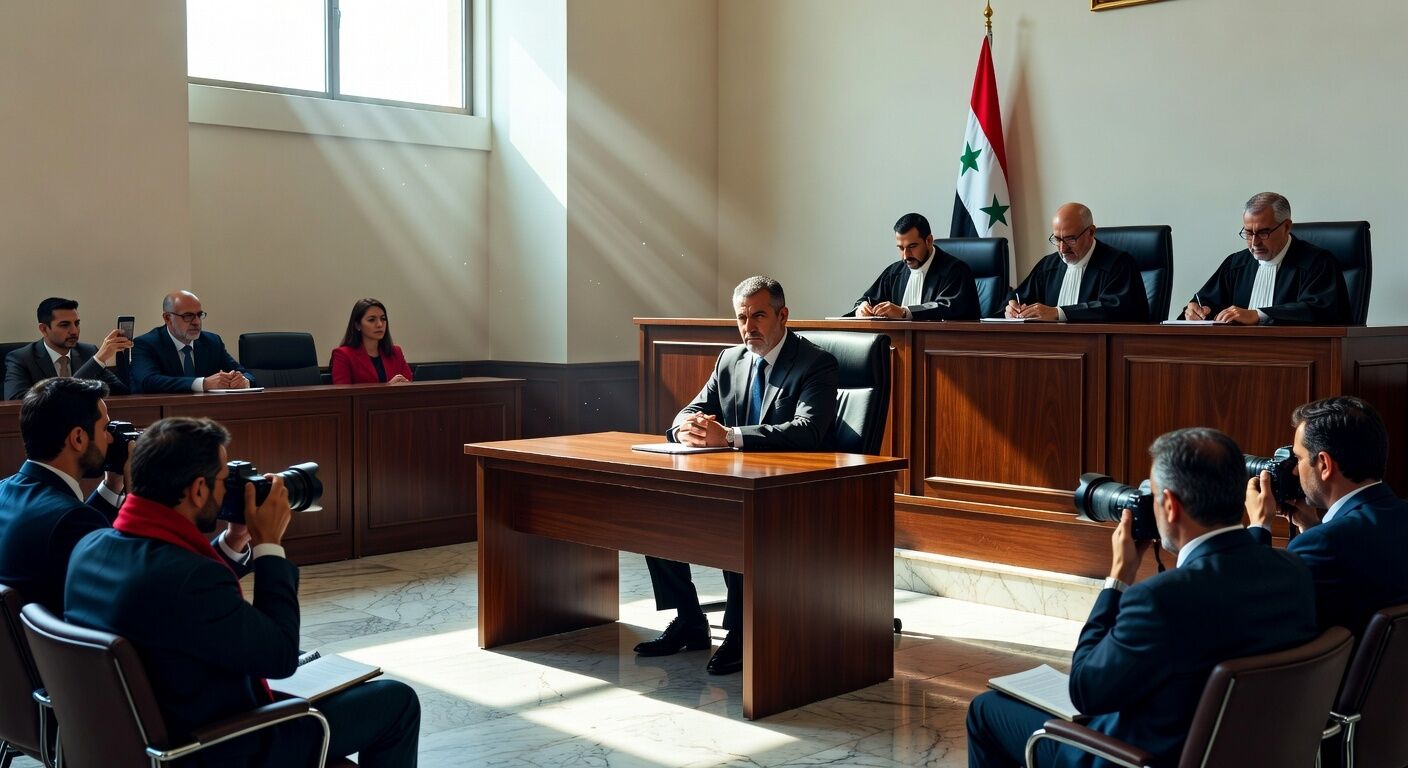
The trial of Atef Najib opened in Syria on April 26
The Trial of Atef Najib: A Critical Test for Syria’s Path to Accountability
By Fatima Al-Rashid Global1.news, Ramallah – May 7, 2026
The opening of proceedings against Atef Najib in Damascus on April 26 marks one of the most closely watched moments in Syria’s halting journey toward justice. Najib, a former intelligence officer long accused of orchestrating the brutal crackdown on peaceful protesters in Daraa in 2011, now faces charges framed as “crimes against the Syrian people.” Human Rights Watch researcher Hiba Zayadin, reporting from the Syrian capital, underscores a vital caveat: perpetrators must be held accountable, yet accountability endures only when the judicial process itself is robust, transparent, and victim-centered.
From Daraa’s Streets to the Courtroom
Najib’s name surfaced early in the Syrian uprising. As head of political security in Daraa, he reportedly ordered the arrest and torture of teenagers who had scrawled anti-government graffiti. Those detentions ignited nationwide protests that the Assad regime met with lethal force. Thirteen years later, the same man sits in a Syrian courtroom, no longer shielded by the old security apparatus.
The charges are sweeping. Prosecutors cite systematic torture, arbitrary detention, and the targeting of civilians—acts that helped propel Syria into a conflict that displaced more than half the pre-war population. Families who lost loved ones in those first weeks now watch the proceedings from exile in Jordan, Lebanon, Turkey, and Europe. Many still carry the photographs of sons and daughters who never returned from Najib’s detention centers.
HRW’s On-the-Ground Assessment
Speaking from Damascus, Hiba Zayadin has emphasized that the legitimacy of this trial will be judged not only by its verdict but by its fairness. “Perpetrators should be held accountable,” she stated, “but accountability only lasts if the process itself is solid.” Zayadin noted the presence of international observers and civil-society monitors, yet warned that incomplete access to evidence, restricted defense rights, or politicized sentencing could undermine years of documentation work by Syrian and international groups.
HRW has long called for trials that meet international standards. The organization’s researchers have compiled thousands of pages of witness statements, satellite imagery, and smuggled prison documents. These archives now sit in The Hague, New York, and European capitals. Whether Damascus incorporates them—or sidelines them—will reveal how seriously the new authorities treat transitional justice.
The Stakes for Displaced Communities
For the millions of Syrians still unable to return home, the Najib trial is more than a legal proceeding; it is a referendum on whether Syria can offer safety and dignity. Displacement is not merely physical. It is the daily reality of stateless children born in camps, of doctors barred from practicing, of farmers whose lands remain mined or confiscated.
In Ramallah, where I speak regularly with Palestinian families who have lived generations under occupation, the parallels are impossible to ignore. Both contexts demonstrate that justice delayed is not merely justice denied—it is an open wound that festers across borders. When Syrian refugees in Lebanon hear that a senior security figure is finally facing charges, hope flickers. When the process appears rushed or selective, that hope dims quickly.
Building a Credible Process
A solid accountability mechanism requires several pillars. First, independent judges must be insulated from political pressure. Second, victims and their representatives must enjoy meaningful participation, including the right to present evidence and question witnesses. Third, the court must operate transparently, publishing indictments, hearing schedules, and reasoned judgments.
International support can help. European governments and the United Nations have already offered forensic expertise and training on chain-of-custody standards. Syrian diaspora lawyers are ready to serve as amici curiae. Yet external assistance must never substitute for Syrian ownership. Justice imposed from abroad rarely heals local wounds.
Looking Ahead
The coming weeks will test whether Syria’s judicial institutions can rise above the legacy of impunity that defined the previous era. Najib’s trial is only the beginning. Dozens of other high-ranking officials remain at large or in custody awaiting proceedings. Each case will either reinforce or erode public trust.
As someone who has reported on displacement from Gaza to the Bekaa Valley, I have learned that accountability is not a single verdict. It is the slow, painstaking construction of a society where no one is above the law. Syria’s people deserve nothing less.
The eyes of the region remain fixed on Damascus. For the families who first raised their voices in Daraa fifteen years ago, this courtroom may finally deliver the recognition they have sought for so long—if the process itself proves worthy of their sacrifice.
---
Additional reporting draws on Human Rights Watch documentation released via its YouTube channel on May 7, 2026, featuring on-site analysis by Hiba Zayadin in Damascus.
This is Fatima Al-Rashid for Global1.news.
Source: HRW via YouTube — 2026-05-07T14:18:12+00:00.
- Breaking News Analysis
- World Politics
- Business & Economy
- Technology & AI
- Science & Health
- Environment & Climate
- Culture & Society
- Travel & Tourism
- Sports & Entertainment
- Investigative Journalism
- Opinion & Commentary
- Media & Journalism
- Human Rights & Social Issues
- Education & Knowledge
- Citizen & Amateur Journalism
- Other News Topics

 English
 Arabic
 French
 Spanish
 Deutsch
 Turkish
 Dutch
Dutch
 Italiano
 Russian
 Romaian
 Portuguese (Brazil)
 Greek
Greek