


AI Skills Pact Unveiled: How 2026 Global Regulations Are Reshaping Workforce Training
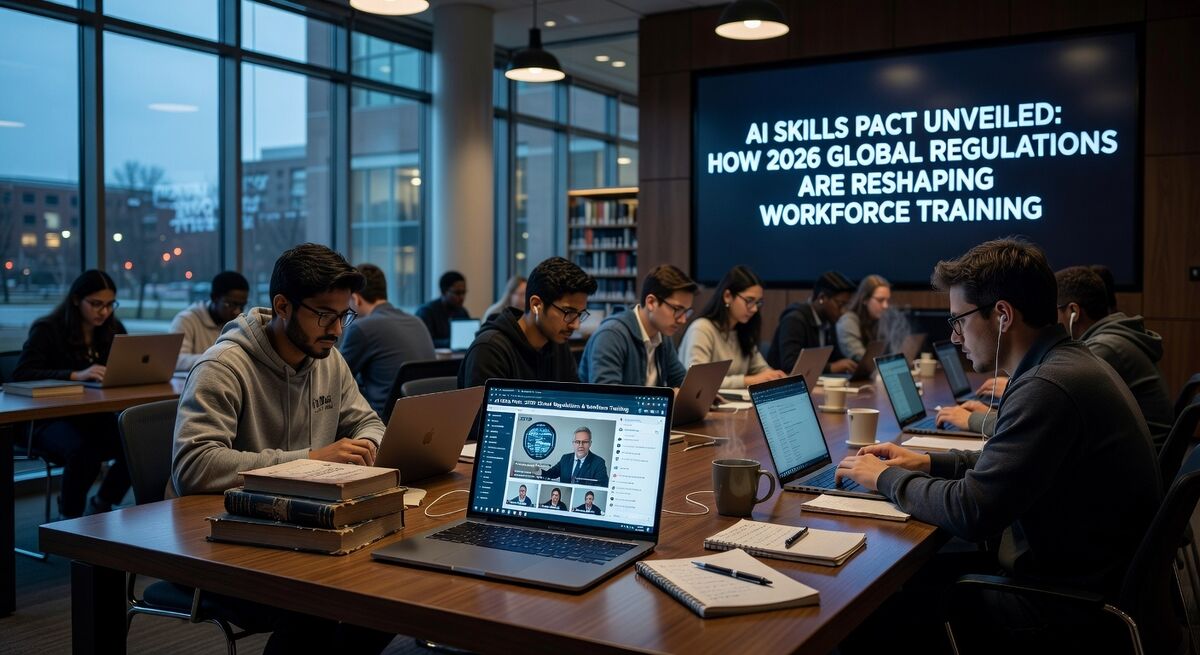
AI Skills Pact Unveiled: How 2026 Global Regulations Are Reshaping Workforce Training
AI Skills Pact Unveiled: How 2026 Global Regulations Are Reshaping Workforce Training
In January 2026 the European Commission launched the AI Skills Pact, a sweeping agreement designed to equip ten million workers across the continent with artificial intelligence competencies by 2030. The move follows mounting pressure from rapid US and Chinese advances in generative systems and comes amid fresh export restrictions on advanced chips that have slowed European tech deployment.
The pact is policy document. It signals a broader geopolitical recognition that nations lagging in AI adoption risk permanent economic disadvantage. European labour ministers have tied the initiative to recovery funds, requiring member states to report quarterly progress on certification uptake and online degree enrolment.
Why the Pact Matters Beyond Europe
Although framed as an EU programme, the ripple effects are global. Companies operating in regulated sectors such as finance, healthcare and manufacturing now face compliance deadlines that demand demonstrable AI literacy among staff. Recruitment postings increasingly list "AI certification" or "recognised online degree in data science" as baseline requirements.
Analysts at the OECD note that similar programmes are already under discussion in Canada, Japan and parts of Latin America. The common thread is urgency: without structured reskilling, millions of mid-career professionals face displacement as routine analytical tasks become automated.
The Rise of Flexible Learning Pathways
Traditional campus programmes cannot scale fast enough to meet the targets. Consequently, universities and specialist platforms are expanding fully online offerings. A growing number of accredited institutions now deliver complete online degree programmes in artificial intelligence, machine learning and responsible technology governance that can be completed while working full time.
Short-form credentials are proving equally popular. Industry bodies have introduced stackable certifications that combine technical modules with ethics and regulatory content. These micro-credentials are designed to be recognised across borders, allowing professionals to accumulate credits toward a full online degree if desired.
What This Means For You
If you work in any sector touched by automation, the AI Skills Pact and its international equivalents change the return-on-investment calculation for further study. Employers are moving from optional upskilling to mandated competence.
Consider these practical steps:
- Audit your current role for tasks that could be augmented by AI within two years. Roles involving data interpretation, content generation or predictive maintenance are highest priority. - Research accredited providers that offer both short AI courses and longer online degree pathways. Verify whether the institution participates in the European Credit Transfer System or equivalent recognition frameworks. - Prioritise programmes that include live projects with real datasets and explicit coverage of the EU AI Act. Compliance knowledge is quickly becoming a differentiator in hiring. - Track application windows for scholarship funds linked to the Skills Pact. Several member states have already earmarked subsidies for workers in vulnerable industries.
Professionals who begin an AI course or certification programme now will be better positioned when performance reviews incorporate new digital-skill benchmarks later in 2026.
Balancing Technical Depth With Ethical Awareness
One distinctive feature of the 2026 programmes is the integration of governance modules. Learners explore bias mitigation, data protection and algorithmic transparency alongside coding and model deployment. This combination reflects regulatory reality rather than academic preference.
Employers report that candidates who can articulate both the capabilities and the limitations of AI systems progress faster in interviews. An online degree or certification that explicitly addresses these dimensions therefore carries added weight.
Looking Ahead
The AI Skills Pact sets measurable targets, yet success will depend on individual uptake. Those who treat the current wave of regulation as a catalyst rather than a constraint stand to gain the most durable career advantages. Whether through a focused certification or a comprehensive online degree, timely investment in AI competencies aligns personal development with the direction of global labour markets.
This article was prepared by Jessica Ali, Chief Content Director at Global1.news.
- Breaking News Analysis
- World Politics
- Business & Economy
- Technology & AI
- Science & Health
- Environment & Climate
- Culture & Society
- Travel & Tourism
- Sports & Entertainment
- Investigative Journalism
- Opinion & Commentary
- Media & Journalism
- Human Rights & Social Issues
- Education & Knowledge
- Citizen & Amateur Journalism
- Other News Topics

 Arabic
 French
 Spanish
 Portuguese
 Deutsch
 Turkish
 Dutch
Dutch
 Italiano
 Russian
 Romaian
 Portuguese (Brazil)
 Greek
Greek