


The strange case of 3D-printed homes in Cairo, Ill
The strange case of 3D-printed homes in Cairo, Ill
The Unfinished Promise: How a $1.1 Million 3D Printer Left Cairo, Illinois, in the Lurch
By Irina Volkov Global1.news | May 10, 2026
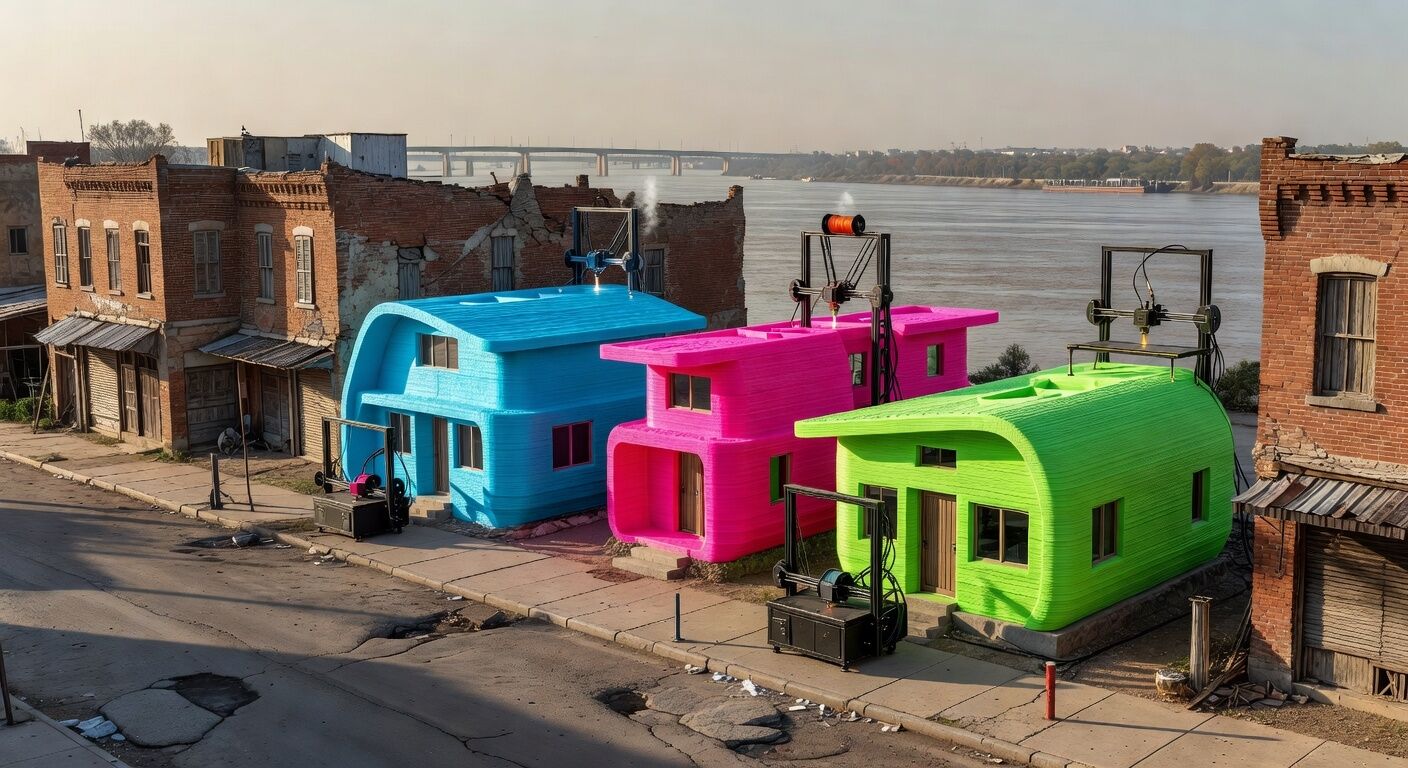
In the decaying river town of Cairo, Illinois, where boarded-up homes outnumber occupied ones and the population has dwindled to fewer than 2,000 residents, hope arrived in the form of a futuristic machine. Two entrepreneurs promised that a massive $1.1 million 3D printer would revolutionize housing, offering affordable, rapidly constructed homes to reverse decades of decline. More than a year later, that vision lies in ruins: a single cracked duplex stands unfinished, the printer has been hauled away, and questions about accountability for public and private funds swirl like the winds off the Mississippi and Ohio rivers.
The story, laid bare in a recent ProPublica investigation released just 38 hours ago, exposes not merely a failed experiment in cutting-edge construction but a troubling pattern of overpromising and under-delivery that leaves vulnerable communities paying the price. As an investigative journalist based in Moscow, I have covered similar grand infrastructure schemes across Eastern Europe and Central Asia—projects sold as saviors that instead become monuments to mismanagement. Cairo’s saga demands the same scrutiny.
Cairo’s housing crisis is no secret. Once a bustling port city, it has suffered from flooding, economic disinvestment, and population flight. Vacant lots and crumbling structures dominate the landscape. Local leaders have long sought innovative solutions to rebuild. Enter the two men behind the 3D-printing venture, who secured funding and permissions to deploy what was billed as a state-of-the-art gantry-style printer capable of extruding entire walls from specialized concrete mix in a matter of days.
The pitch was compelling. Traditional construction is slow and expensive in rural America. A 3D printer, they claimed, could slash costs and timelines, delivering a duplex for a fraction of conventional prices. By May 2025, the machine arrived, and printing began on what was intended as the first of many affordable units. Optimism ran high among city officials and residents desperate for any sign of renewal.
Yet from the outset, red flags emerged. The printed structure quickly developed visible cracks in its walls and foundation. Engineers and observers noted inconsistencies in the extrusion process, possibly stemming from material quality, weather exposure, or operational inexperience. Construction halted. The promised follow-on homes never materialized. By early 2026, the printer itself was dismantled and removed, leaving behind only the skeletal, uninhabitable duplex as a stark reminder of dashed hopes.
ProPublica’s reporting, drawing on documents, interviews, and site visits, reveals a timeline of delays, shifting excuses, and a conspicuous lack of transparency regarding the $1.1 million expenditure. Who ultimately footed the bill—federal grants, state economic development funds, private investors, or a mix—remains partially obscured. What is clear is that no completed, code-compliant housing units resulted. Residents who were promised new beginnings now face yet another empty lot and another round of skepticism toward outsiders bearing technological saviors.
This is not an isolated incident of technological growing pains. Across the United States and globally, 3D-printed construction has generated hype, with companies touting speed and sustainability. But independent evaluations often highlight challenges: structural integrity in varying climates, regulatory hurdles, supply-chain dependencies, and the gap between prototype demonstrations and scalable, reliable deployment. In Cairo’s case, the project appears to have bypassed rigorous pilot testing or third-party oversight that might have caught problems earlier.
Holding power to account requires asking hard questions. Were the two men adequately vetted before receiving access to public resources or community trust? Did local or state authorities conduct due diligence on the printer’s specifications and the team’s track record? What mechanisms exist to claw back funds when deliverables fall short? The absence of clear answers points to systemic weaknesses in how innovative but unproven technologies are greenlit in economically distressed areas.
Community members interviewed by ProPublica express a mix of frustration and resignation. One longtime Cairo resident described watching the printer operate for weeks, only to see work stop abruptly. “We needed homes, not another headline,” she said. City officials, meanwhile, have offered limited public comment, citing ongoing reviews. Such opacity fuels distrust—especially in a region where past revitalization efforts have sometimes enriched consultants more than citizens.
The broader implications extend beyond southern Illinois. As governments worldwide pour resources into climate-resilient and affordable housing, similar 3D-printing initiatives are underway from Austin, Texas, to European pilot projects. Without robust accountability frameworks—independent audits, milestone-based funding, performance bonds, and public reporting—taxpayers and residents risk subsidizing expensive failures. Cairo’s unfinished duplex should serve as a cautionary case study, not an outlier swept under the rug.
Corruption, in its many forms, often hides in the gray zone between sincere ambition and self-interest. Whether intentional deception or simple incompetence occurred here is for investigators and courts to determine. What matters now is that the story does not end with the printer’s departure. Residents of Cairo deserve completed homes or restitution. The entrepreneurs must explain precisely how the $1.1 million was allocated. And policymakers must implement safeguards so that future “innovative” solutions do not repeat the cycle of promise and abandonment.
Technology alone cannot fix structural problems like disinvestment, shrinking tax bases, and regulatory inertia. It requires competent execution, transparent governance, and genuine partnership with affected communities. In Cairo, the 3D printer became a symbol of what could have been. Its removal leaves behind not just cracks in concrete but cracks in public confidence.
As investigations continue and sunlight exposes more details, one thing is certain: Cairo, Illinois, and towns like it cannot afford more half-built dreams. Accountability must follow the money—and the machines—wherever they lead.
This is Irina Volkov for Global1.news.
Source: ProPublica via YouTube — 2026-05-08T21:00:33+00:00.

- Breaking News Analysis
- World Politics
- Business & Economy
- Technology & AI
- Science & Health
- Environment & Climate
- Culture & Society
- Travel & Tourism
- Sports & Entertainment
- Investigative Journalism
- Opinion & Commentary
- Media & Journalism
- Human Rights & Social Issues
- Education & Knowledge
- Citizen & Amateur Journalism
- Other News Topics

 Arabic
 French
 Spanish
 Portuguese
 Deutsch
 Turkish
 Dutch
Dutch
 Italiano
 Russian
 Romaian
 Portuguese (Brazil)
 Greek
Greek