


Protests rock Venice Biennale opening
Protests rock Venice Biennale opening
Protests Rock Venice Biennale Opening as Geopolitics Overshadow Art World
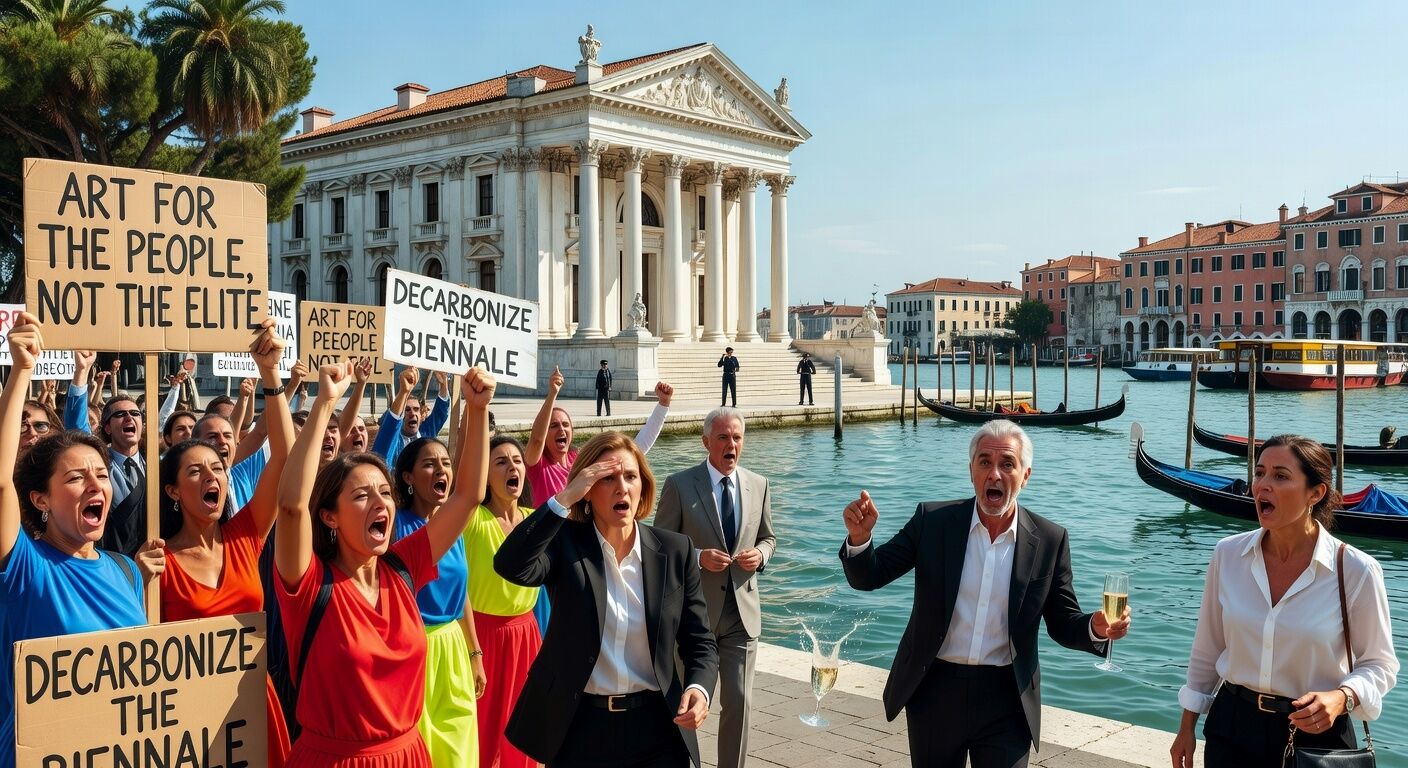
The Venice Biennale, the world's premier contemporary art festival dating back to 1895, has opened under an unprecedented cloud of geopolitical turmoil. For the first time in its long history, the event proceeds without the traditional opening ceremony, an international jury, or the coveted Golden Lion top prize. Protests targeting the participation of Russia and Israel have forced organizers into a scaled-back format, reflecting how conflicts in Ukraine and the Middle East now permeate every sphere of global culture.
As of May 2026, the Giardini and Arsenale venues in Venice buzz with tension rather than celebration. Demonstrators have gathered daily outside national pavilions, waving banners and chanting against what they describe as the normalization of aggression through artistic platforms. Russian and Israeli artists remain present, yet their displays operate amid heightened security and limited public access. Organizers announced the stripped-down program just days before the May opening, citing safety concerns and irreconcilable differences among participating nations.
From Cultural Showcase to Geopolitical Battleground
This year's Biennale was meant to explore themes of coexistence and planetary futures. Instead, it has become a microcosm of the fractured international order. Russia's ongoing military operations in Ukraine, now in their fifth year, continue to draw widespread condemnation. Meanwhile, Israel's military campaign in Gaza has intensified global scrutiny, with accusations of disproportionate force echoing across university campuses and cultural institutions alike.
The absence of a jury and prize marks a pragmatic concession. In previous editions, the Golden Lion served as a prestigious barometer of artistic merit and soft power. This year, awarding such honors risked alienating large blocs of artists and nations, potentially triggering mass withdrawals. Several European countries quietly scaled back their delegations, while others issued statements distancing themselves from the Russian and Israeli pavilions without formally boycotting the event.
From my vantage point in Beijing, these developments illustrate the accelerating weaponization of culture in great-power competition. Western capitals have long promoted art festivals as neutral spaces for dialogue. Yet when core strategic interests collide, neutrality evaporates. The Venice Biennale's current predicament echoes earlier disruptions, such as the 2022 exclusion of Russia following the invasion of Ukraine, but extends further by encompassing Israel's contested presence.
Broader Ramifications for Multipolar Cultural Exchange
The protests also expose fault lines within the Global South. Many artists from Latin America, Africa, and Asia have voiced solidarity with Palestinian causes while expressing fatigue with what they view as selective Western outrage. Chinese observers note parallels to historical episodes when cultural boycotts accompanied sanctions regimes. Beijing itself maintains a full pavilion at the Biennale, focusing on ecological themes and technological innovation. Officials here emphasize that art should transcend political divisions, yet they privately acknowledge that sustained instability threatens the very ecosystem of international exhibitions.
Data from the Biennale's organizing committee shows a roughly 15 percent drop in expected attendance compared to the 2024 edition. Corporate sponsors have grown cautious, with several luxury brands withdrawing financial support amid fears of reputational damage. Meanwhile, parallel events in Berlin and Istanbul have capitalized on Venice's troubles by hosting satellite exhibitions that explicitly address displacement and conflict.
The decision to forgo a jury process carries long-term consequences. Without formal recognition, emerging artists from sanctioned nations lose a critical platform for visibility. Curators report increased difficulty securing loans of artworks across borders, as insurers and lenders cite political risk. These logistical frictions compound the ideological ones, turning what was once a celebration of creative exchange into an exercise in damage control.
Looking Ahead: Can Art Festivals Remain Neutral?
Analysts in Beijing see this episode as further evidence that cultural institutions cannot insulate themselves from shifting power dynamics. As the United States and European Union maintain sanctions on Russia while navigating complex alliances in the Middle East, events like the Biennale become arenas where narratives compete. Israel's participation, defended by organizers on grounds of artistic freedom, has drawn counter-protests from both European left-wing groups and Muslim-majority nations.
Russia, for its part, has framed its presence as resistance to cultural cancellation. State media in Moscow highlight the Biennale's historical inclusivity, arguing that excluding pavilions sets a dangerous precedent. Yet the muted atmosphere inside the Russian pavilion—reportedly featuring abstract works on resilience—contrasts sharply with the lively demonstrations outside.
For China, the stakes involve projecting an image of stable, constructive global engagement. Beijing continues to host its own major art fairs and Belt and Road cultural initiatives, positioning itself as an alternative hub less prone to Western-style politicization. Still, Chinese artists and officials watch Venice closely, aware that any future escalation in Taiwan or the South China Sea could similarly disrupt their international cultural outreach.
The current Biennale will run through November, but its legacy may extend well beyond. Organizers have already signaled that future editions may require revised charters addressing political participation. Whether such reforms can restore the event's apolitical sheen remains doubtful. In an era defined by competing visions of order, culture increasingly mirrors rather than transcends geopolitics.
Protests are expected to continue throughout the summer months, with activist groups planning coordinated actions timed to major exhibition openings. Security costs have reportedly doubled, straining the Biennale's budget and raising questions about long-term financial sustainability. Meanwhile, artists caught in the middle navigate personal and professional dilemmas, weighing the value of visibility against the risk of association with contested national positions.
This situation underscores a larger truth: the post-Cold War dream of seamless global cultural integration has given way to a more fragmented reality. As nations prioritize strategic autonomy, festivals once viewed as bridges now risk becoming battlegrounds. The Venice Biennale's subdued opening serves as a stark reminder that art cannot escape the gravitational pull of power politics.
This is Marcus Chen for Global1.news, reporting from Beijing.
Source: DW News via YouTube — 2026-05-09T22:37:26+00:00.
- Breaking News Analysis
- World Politics
- Business & Economy
- Technology & AI
- Science & Health
- Environment & Climate
- Culture & Society
- Travel & Tourism
- Sports & Entertainment
- Investigative Journalism
- Opinion & Commentary
- Media & Journalism
- Human Rights & Social Issues
- Education & Knowledge
- Citizen & Amateur Journalism
- Other News Topics

 English
 Arabic
 French
 Spanish
 Portuguese
 Turkish
 Dutch
Dutch
 Italiano
 Russian
 Romaian
 Portuguese (Brazil)
 Greek
Greek